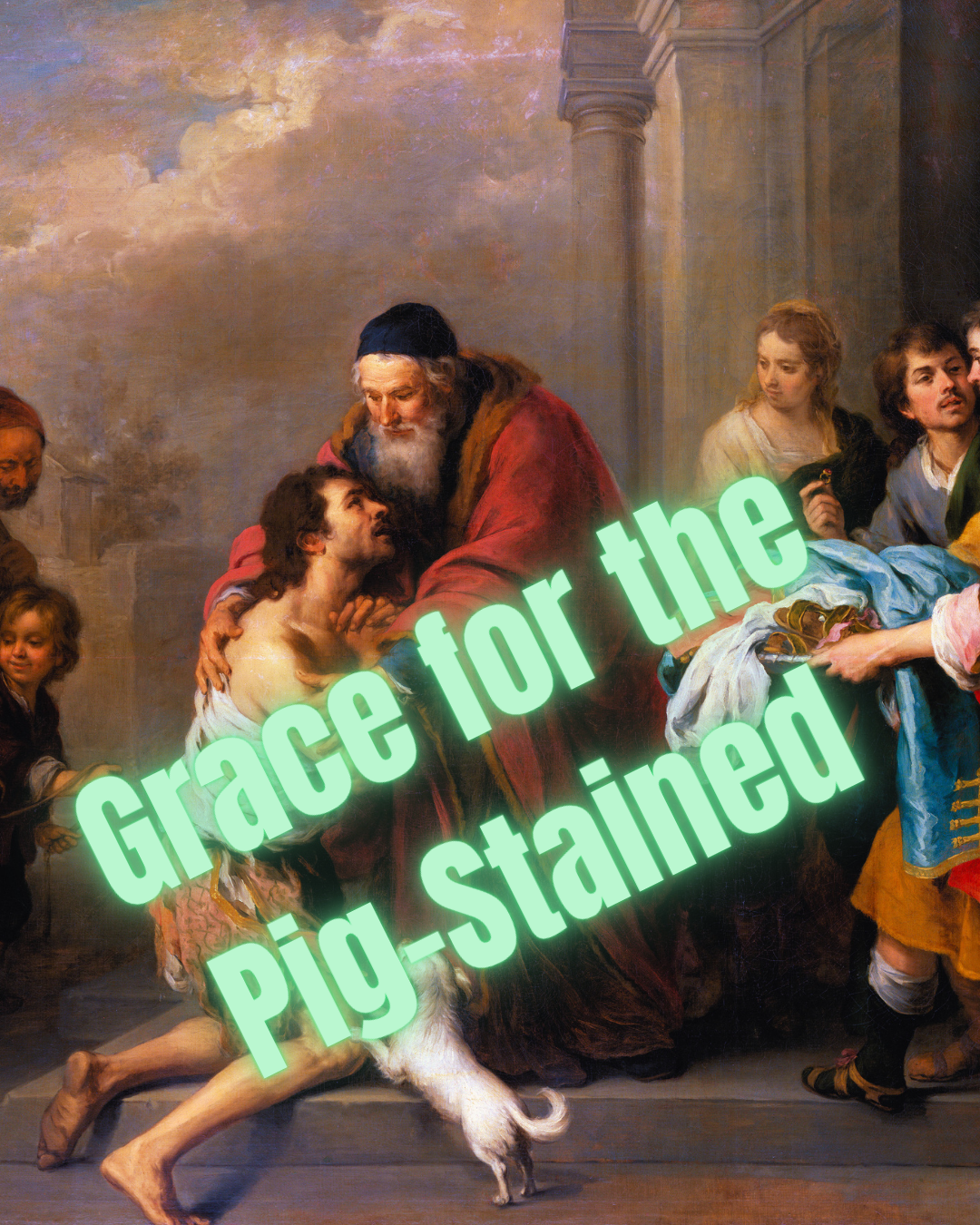
Grace for the Pig-Stained
The grace of the Lord Jesus Christ, the love of God, and the communion of the Holy Spirit be with you all. Amen.
Today’s theme could just as easily be “lost and found.” The sheep is lost. The shepherd goes off, finds it, and rejoices. The coin is lost. The woman tears her house apart, finds it, rejoices. The son comes to the father and says, “I wish you were dead. I want what’s coming to me. I want the third of my inheritance of your estate.” Because the oldest son gets two‑thirds, since he has to take care of Mom and any sisters. So he gets two‑thirds; he gets a double portion. So the younger son comes up and says, “I wish you were dead so that I could do what I want.”
And he goes off to a far country and wastes the inheritance. He parties. He lives it up. And what happens? He loses it all. A famine hits—God’s wrath on that land. A famine hits, and he’s out there with the pigs. All that money he spent, he didn’t gain a single friend who would even be willing to feed him in his need. And I don’t know if you know anything about pigs—my wife’s family, their farm in Iowa—twenty years later you can still smell the pigs, and it’s not a pleasant smell.
So this is an Israelite who is supposed to have nothing to do with pigs to begin with, and he is longing for the pig slop.
He’s in such dire straits. He’s the son who is lost, the son who is dead. And I love this verse here: “But when he came to himself.” When he came to himself. See, our sinful nature is in rebellion to God. Our sinful nature thumbs its nose at God and says, “I wish you were dead so I can go off and do what I want.” And then what happens is we go off, we do what we want, and we find that it leads to the pigs, and we smell like a pig, and we wish we could just eat the food the pigs eat because our life is such a disaster.
But when we come to ourselves—when we come to that which is right, that which is good—when we remember that God actually desires a relationship with us, that He wants what is best for us, and He has laid this out in His Word, that we are not supposed to be opposed to God but are supposed to be His child, that He is a loving Father—we repent. And we realize we’re not even worthy to be called a son, but maybe God will let us into His house to be a servant.
We’ll work in the fields all day. We’ll get sweaty. We’ll get calluses on our hands. But it will be better than being in the midst of the pigs.
And the father is sitting there, and the father never stops looking for his son. His son is a long way off, and the father sees him and runs to him.
Do you know how undignified that is in that culture? The father shouldn’t be running to the son. The son should be running to the father.
The father runs to him. He gathers him up. He probably still smells like pig filth. His clothes are tattered. His sandals are falling apart. He was destitute when he left; he’s in worse condition coming home.
And the son starts to recount his repentance: “I have sinned against you and against heaven. I am no longer worthy to be called your son.” And the father cuts him off. He doesn’t even get to the part of “Let me be your servant.” The father cuts him off and shouts to the servants, “Bring quickly the best robe.” He smells like pig poop, but put the best robe on him. Put sandals on his feet. Put a ring on his hand. And get the party ready, because my son who was dead is alive.
And this is how God treats us worthless sinners. He runs to us even though we are far off. He sends His Son to seek us. He covers our sin in the blood of Jesus Christ. Even though we were enemies of God, yet He still loved us.
He not only creates us, but He desires us to be His children. This is the radical love of God. He acts in such an undignified manner. The Lord of the universe—Christ Himself, through whom everything was made—comes into our flesh. He spends nine months in gestation. He is birthed with all the messiness that entails. I love the hymn but it was not a quiet night.
There was probably a lot of screaming. Mary probably had a few choice words coming out of her mouth.
Jesus is a baby. The Lord of the universe poops His pants and has to be wiped.
Do you know how undignified that is? This is the King of everything, the One to whom everything should be in obedience. And yet He comes down and condescends to go through everything that you have gone through, to come into His creation because He loves you that much. He doesn’t give a flip about dignity. He loves you that much. He debases Himself, suffering even death upon a cross. “Cursed is he who is hung upon a tree.” He undergoes the death of criminals—the death so horrific that the Romans wouldn’t even speak about it in polite company. We only get a few sentences ever written about it. The most complete accounts of a crucifixion are literally the Four Gospels.
This is how much God loves us.
And the eldest son—he gets mad. “Listen, I’ve been here for years. That son of yours—he ran off for years. I’ve been here doing the hard work. I’ve been here earning it all back that he went and wasted. You didn’t even give me a young goat.”
And notice the father’s reply: “Son, you are always with me. All that is mine is yours.” If you want a goat, take a goat. If you want to have your friends over, have your friends over.
But notice this: “It was fitting to celebrate and be glad, for your brother…” Did you catch it? The older brother says, “This son of yours,” and the father replies, “Your brother was dead and is alive. He was lost and is found.” And this is where the parable ends. And why does it end here? Because when the father says it, it’s done. It’s over. He has the ultimate say. And the ultimate say is this: that this guy, this brother of yours, is still your brother. Even though he lived a horrible life and partied it up and squandered it, he was dead, but he’s alive now. And he is your brother. He is your brother because I have declared him so. He is your brother because he is alive once again.
Micah, foreshadowing this radical love of God, says in our Old Testament passage, Micah chapter 7: “Who is a God like you, pardoning iniquity and passing over transgression for the remnant of His inheritance?” There is no forgiveness like the forgiveness in Jesus Christ. There is no forgiveness like there is in Jesus Christ.
We live in a world that has cancel culture. We have coined the term, and it’s on both the right and the left. You say the wrong thing, and suddenly your friends have nothing to do with you.
But in the Church, we approach one another in forgiveness and grace and love. There is only one unforgivable sin. This is why we call people to repentance. This is why we go to them as brothers and sisters and say, “Hey, there’s something in your life that’s not living up to how we’re supposed to live.” Not because we hate them, but because we love them—because we’re supposed to treat them in brotherly love. We don’t do it to slander the Church or scandalize people.
We do it because of God’s grace.
We live out this radical grace in our world.
The world doesn’t understand it. In many ways, the world is like the older brother: “Why do I need forgiveness? Why do I need grace? Why would I want anything to do with that guy over there? I don’t want anything to do with you.”
And the answer is: it’s better. This is how we’re supposed to live. We’re supposed to live in communion with God. It’s better for us because this is the right thing. It’s better for us because we’re not following our whims and wishes that lead to the pig slop.
We’re following the Father, and it leads to His house where there are many rooms. It leads to the banquet and the feast He has prepared before us. It leads to life everlasting.
Because it’s based upon the love and grace of God.
We don’t often picture dads as being the loving part of the family. Usually Dad’s the one—“Just wait till your father gets home.” Dad’s got to be the law. Dad’s got to be the stern one. Everything else: “Go ask your mother.” But when Mom comes to Dad, things are bad.
But in God we get the example of a loving Father—one who pardons all iniquities. One where Mom has gone, “Do you know what this son of yours has done?” And the Father says, “Yes—and My Son Jesus Christ has paid for it.” In Christ’s name. Amen.
Want to learn more? Read last week’s sermon here!