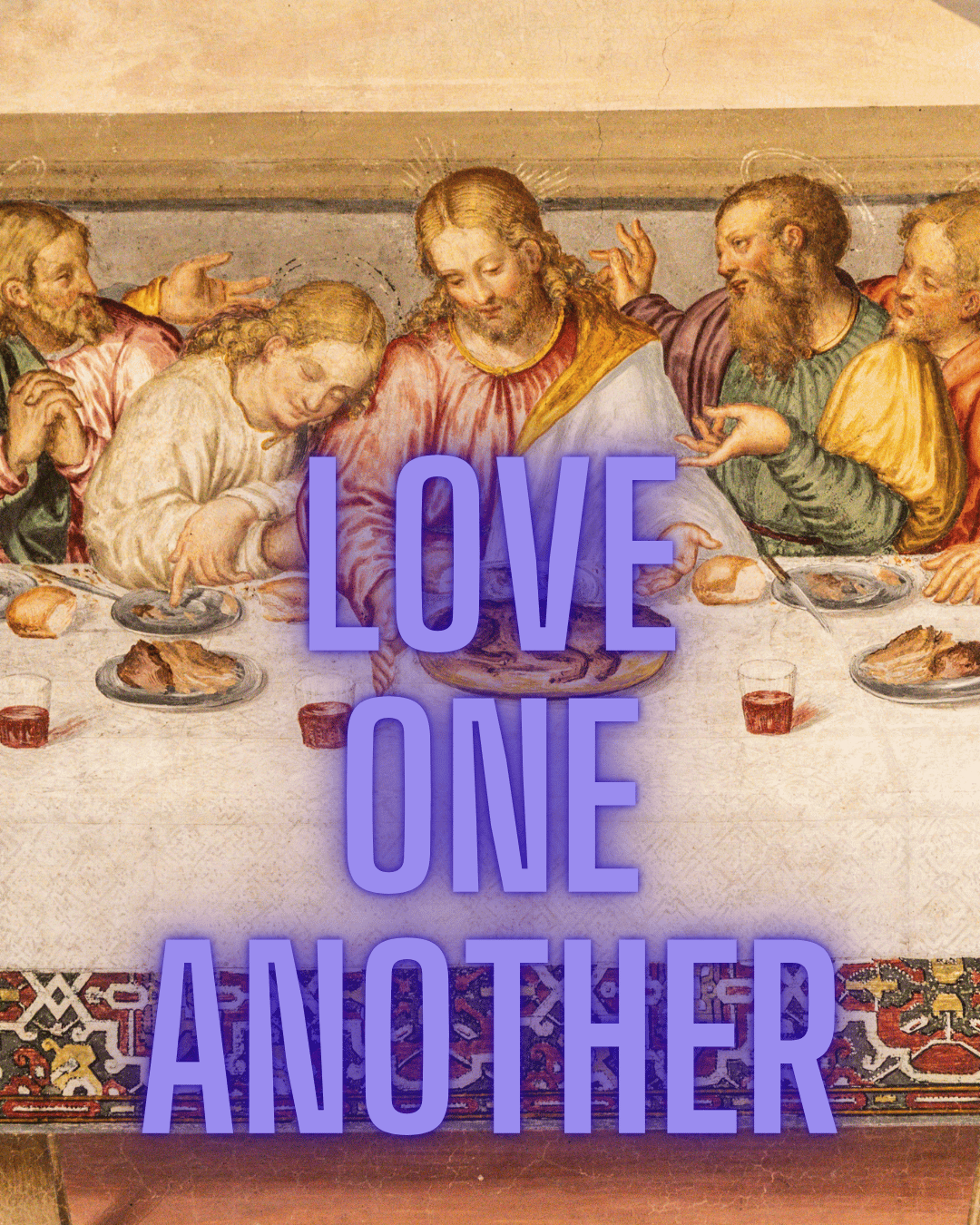
Love One Another
The grace of our Lord Jesus Christ, the love of God, and the communion of the Holy Spirit be with you all. Amen.
Christ is eating the Passover meal with His disciples. It is not yet the official Passover, but Jesus will be “a little tied up” on that day, to put it lightly. Part of the Passover ritual involved washing—washing your head, washing your hands—but not necessarily washing your feet.
Then the Lord does something shocking. He is their teacher, their rabbi, and their Lord—in other words, their God. And in the middle of the meal, He stands up and begins to wash their gnarly, dirty, stinky feet. Most of us don’t want to think about feet while we’re eating, but Jesus does this to give them one final moment of teaching together.
Later that night, He will go to the garden. He will leave eight disciples in one place, take three farther in, and then go beyond them to pray. They will keep falling asleep. He will be arrested. He will be tried illegally—the Sanhedrin was forbidden from trying anyone at night. In the morning He will confess, “Yes, I am the Lord,” and they will hand Him over to Pilate. Pilate will send Him to Herod, Herod will send Him back, and by tomorrow afternoon Jesus Christ, the Lord of the universe, will be dead.
All of this is according to God’s plan. This is what God meant in the garden when He told the serpent that the offspring of the woman would crush his head and the serpent would bruise His heel. This is what He promised through the prophets—that the Lord Himself would come to save His people.
And now, in this moment, Jesus says: If you take one thing from all of this—one final lesson—let it be this: Love one another as I have loved you. The word for love here is agape—sacrificial, all‑encompassing love, the highest form of love.
Sometimes when teaching children, we summarize the second table of the law as “Don’t be a jerk. Be nice.” But that only tells them what not to do. Christ commands a positive action. It’s like temperature: we don’t measure cold; we measure heat or the lack of it. When it’s 81 degrees, it means it’s missing 19 degrees of heat to reach 100. Simply telling someone “Don’t be mean” still allows them to be neutral, ambivalent, or indifferent.
But Christ does not treat us that way. “As I have loved you, love one another.” Go the extra mile. Care for those around you. Love your neighbor. Consider their well‑being. Pray for them. If they are hungry, feed them. If they are cold, clothe them. Do what is best for them—even if they dislike you, even if they hate you.
Jesus says this to people who are literal siblings, men who have spent three years arguing, even once about who would be the greatest among them. Men He has repeatedly tried to teach, “It’s not about you. It’s about the blood of the Lamb poured out for you and for all people. Seek first the kingdom of God and His righteousness, and all these things will be added to you.”
Love one another as I have loved you.
And how has Christ loved us? He is the Lamb who takes away the sin of the world. He takes away your death. He silences the accusations of Satan. He removes what is killing you and gives you the resurrection. When you lose a loved one, He gives you the promise that you will see them again. As your body breaks down, He gives you the promise of a new, imperishable body.
I have metal in my left knee from surgery when I was seventeen. Some days I try to play basketball with my son, and some days I last only a few minutes before something tweaks and I say, “That’s enough for Dad.” Christ gives us a body that will never break down. He wipes away the scars on our souls and hearts.
This is the love of God. And this is the love we are called to have for one another—to live as people of love. Jesus says this is what will distinguish His people from the world. In the Old Testament, the distinguishing marks were clothing, hair, food laws—no bacon, no lobster, no crab, all the good stuff. That’s how the nations recognized God’s people.
But now Christ calls people from every nation, Jew and Gentile alike, and the distinguishing mark is love—sacrificial love for one another.
It is a powerful message. It is the message of the forgiveness of sins. I wish it were easy. I have siblings. I was a teenager once. I now have children and am already dreading their teenage years. We live in a sinful world. I am a sinner.
But just as God has done this for me, He has done it for you. He has given you a new heart, regenerated your will, called you to holy living, and given you His Holy Spirit so that, with His help, you can begin to love as He commands. And when you fail, you can rely on His forgiveness. You can make amends with the brother or sister you did not love perfectly. Through the love of Christ, you can be reconciled.
As we prepare to observe the reconciliation of the entire world tomorrow, may we remain in the love of Jesus Christ.
In His name. Amen.